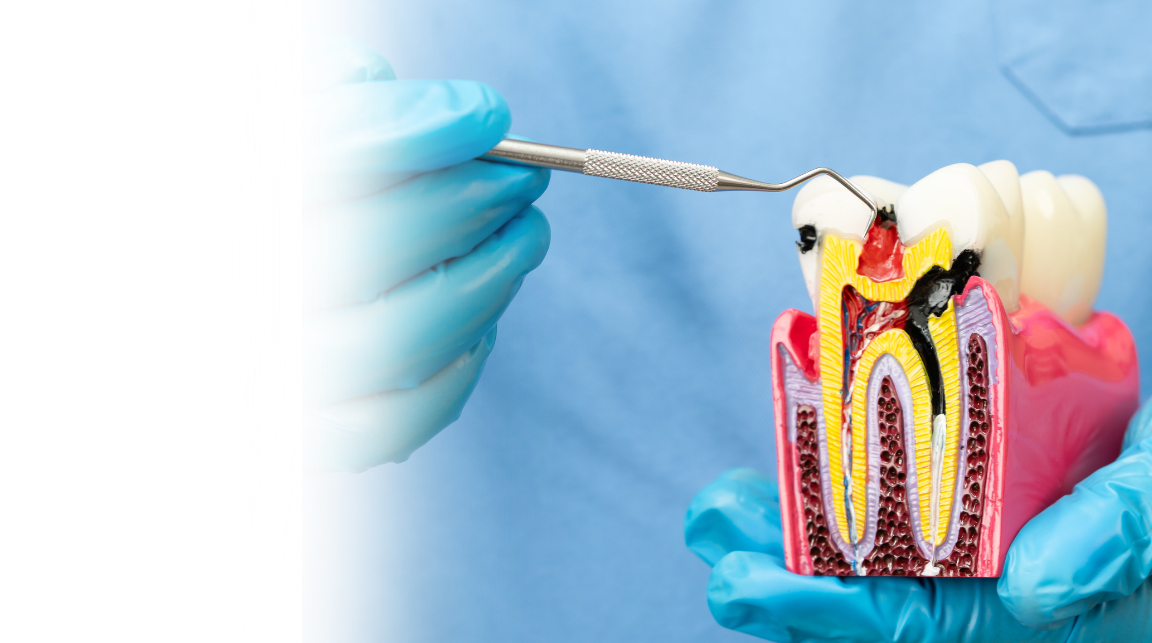
Think of your tooth like a house. The enamel and dentin form the outer walls. Inside sits a soft room called
the pulp, and that room holds the nerve and blood supply keeping the tooth alive.
A deep cavity does it. So does an old cracked filling, or a hard knock on the tooth. Bacteria find a way into
that room and, once they’re in, they don’t leave on their own. That’s the pain that wakes you up at night.
A root canal empties the infected tissue, cleans the narrow passage inside the root, and seals it. Nothing
about the outside of your tooth changes. You’re losing the infection here, not the tooth.
People imagine drills and a long ordeal. Honestly, it isn’t.
We start with a cold test for the nerve, then an X-ray to check the root. Some roots run straight. Others
curve like a question mark, and that picture decides how we approach the rest of the visit.
Next comes numbing, then a rubber dam goes around the tooth so the area stays dry. A small opening reaches the
infected pulp. An apex locator measures the tooth canal so cleaning stops right at the root tip, not short of
it, not past it. Rotary files shape the canal after that.
The space gets packed with gutta percha, a material dentists have used to fill root canals for over a century,
and a filling or crown goes on last to close everything up.
A straightforward case finishes in one visit. A stubborn infection or pus that needs draining first means two
sittings, and we tell you why, upfront.
Not every infected tooth needs the same fix. Single sitting RCT works when infection is caught early and
canals cooperate. Re RCT, or retreatment, comes up when an old root canal leaks, or a canal got missed the
first time, common in back molars hiding four or five canals instead of three.
Tricky canals get magnification through microscopic root canal treatment, or laser assisted disinfection for a
deeper clean. A tooth that’s lost too much structure gets a post and core before the crown goes on.
A tooth you keep is a tooth that keeps working. It bites. It chews. It holds its neighbours in line and
keeps the bone underneath it active. Pull it out, and that bone quietly starts shrinking within months,
something nobody warns patients about at the time.
There’s an appearance win too, since a treated, capped tooth looks like every other tooth around it. Most
patients can’t even tell you which one it was a few months later.
Decayed, cracked, infected, most adult teeth qualify if the bone around the root is holding up okay. Teeth
drilled and filled one time too many, and gone touchy on their own, often qualify too.
A tooth fractured below the gum line is a different story. So is one sitting in bone that’s already broken
down. Extraction makes more sense there, and we say so plainly rather than push a treatment that won’t hold.
Cost hinges on the tooth, how many canals it has, how far the infection has spread, and whether a filling or a crown finishes the job. A single canal front tooth costs less than a back molar carrying three or four canals of work.
Surprise bills aren’t something we do. Once the exam and X-ray are done, you get the full picture before
anyone picks up an instrument.
📞 Call / WhatsApp: 9019903231
Most people feel real relief within a day or two, once the pressure from the infected pulp is gone. Soreness
on biting for two or three days is normal and eases off with the medicine we give you.
A crown, if needed, goes on one to two weeks later. Done properly, a root canal can last many years, sometimes
for good, provided you keep up with checkups and normal brushing.
Root canals are common, done for decades without harming the rest of the body. There was an old theory
floating around that they caused illness elsewhere in the body. It turned out to be false, and it’s been
checked more than once.
Some soreness for a couple of days is normal. If pain gets worse after a week, or swelling comes back, or
there’s a bad taste that won’t go away, that’s not normal. Come in and get it checked instead of waiting.
Every dentist on our team is registered with the Dental Council of India and trained in root canal therapy
using rotary and laser assisted systems. Rubber dam isolation isn’t for special cases, it’s how we treat every
tooth, keeping things clean and the sitting shorter.
Cost and the plan get explained before anything starts. Any crown or cleaning around the treated tooth happens
in the same visit, not a separate one later.
Keeping your own tooth also keeps the jawbone under it active. Pulling the tooth is faster, and might cost
less that same day.
A bridge or an implant usually follows to fill the gap though, and that adds up to more money down the line.
If the tooth is infected but the structure underneath is still solid, keeping it is generally the better call.
A tooth that hurts when you bite down is one sign. So is a jolt from something hot or cold that doesn’t fade
quickly, or a gum bump that keeps coming back.
None of these should be ignored, since the infection just spreads further into the bone the longer it sits,
and the case only gets harder to treat later. If the X-ray shows enough healthy tooth and bone left, a root
canal still makes sense.
Come in for a proper look. Our team will check the tooth, explain what’s actually happening inside it, and go
over the treatment that fits your case.
Once the root canal is done, we can also handle the crown or a cleaning in the same visit.
📍
20/B, First Floor, KD Road, 1st Cross Road, behind Chandramouleshwara Temple, Jayalakshmipuram, Mysuru,
Karnataka 570012
📞 Call: +91 9019903231
💬 WhatsApp: +91 9019903231
✉️ umbrellaaesthetics@gmail.com
Discover beauty at Umbrella Aesthetics. Experts cater to dental, skin, and hair needs. Immerse in tranquility. Schedule today.
Jayalakshmipuram, Mysuru
9019903231